Classes in 2026
Making and Carving a Brettstuhl
Monday – Friday, February 8 - 13, 2026
Pratt Fine Arts
Seattle, WA
Learn to make a vernacular two-board chair in an Alpine vernacular. This class is centered around joinery, relief carving, and design. Students will use hand tools to create components and joints, including tapered sliding dovetails and through-tenons. Each student will also develop a vocabulary in pattern carving throughout the week. Finally, students can either work from a template and carve their chair or compile their own practiced patterns onto a chair back of their own design. All levels are welcome; elements of this class may be physically strenuous.

Bygones: Combs, Spoons, & Treen
April 26 - May 1
Penland School of Craft
In this workshop we will explore love tokens and other useful wooden bygones. Historically, these decorated objects were gifts used to capture a sentiment or moment in time: a consecration, a courtship, a voyage. Combinations of symbols and motifs would describe a complex idea. How can we compile a symbolic language to speak of our own moment, our own sentiments? With a focus on handwork and green woodworking techniques, we will design, make, and carve different forms beginning with the love spoon and ending with the H-comb. Throughout the workshop, we’ll also discuss patterns, user-made tools, and how to incorporate foraged materials into our process.

Pattern Carving
May 16 - May 17, 2026
Peters Valley School of Craft
In this class, each participant will develop their own vocabulary of carved patterns. We’ll ask how to capture shadow, how to reinterpret historic patterns, how and where to use comfortable shapes and lines, and how to compile and arrange decorative elements within the form. Using an assortment of gouges, we’ll spend time learning tool strokes and carving motifs, gaining inspiration from historic furniture, architectural carving, folk art, tattoos, plants, flowers, scaled animals, and so on.

Making and Carving a Brettstuhl
May 24 - May 31, 2026
John C. Campbell Folk School
Learn to make a vernacular two-board chair in an Alpine vernacular. This class is centered around joinery, relief carving, and design. Students will use hand tools to create components and joints, including tapered sliding dovetails and through-tenons. Each student will also develop a vocabulary in pattern carving throughout the week. Finally, students can either work from a template and carve their chair or compile their own practiced patterns onto a chair back of their own design. All levels are welcome; elements of this class may be physically strenuous.
Function and Pattern: Carving for Everyday Objects
June 15 - June 19, 2026
Pocosin Arts School of Fine Craft
Over the course of a week, students will dive into pattern carving and explore its applications on functional objects. Students will have the chance to learn different motifs and techniques from a handful of carving traditions. While developing our decorative vocabulary, we’ll make a wall hanging, a piece of treen, or take the opportunity to develop something new altogether. This class will have a strong focus on handwork and hand-tool joinery.

Stick Chair Studio w/ Charles Thompson & Andy Glenn
August 10-15, 2026
Waldoboro, ME
What makes a good stick chair? Well, there are plenty of answers to that question. No two stick chairs are quite the same. There’s a bit of alchemy in making them: one part creative impulse, one part inherent material characteristics, one part desired functionality. In this class, we’ll explore some of the things that make stick chairs special.
Students will each have the opportunity to imagine, design, and build their own unique chair. These can be based on provided forms, historic examples, or something entirely new. We’ll tackle the design process with individual attention and as a class under the guidance of instructors Andy Glenn and Charles Thompson. Then, through a mixture of greenwoodworking and working with dry stock, we’ll bring our chairs into the world.
Some questions we can expect to tackle are: What’s comfortable? What proportions should I aim for? How tall, thick, or thin should this part be? How can I guide an eye around my work? What joint works here?
There is pre-class prep. We ask each student to sketch their chair idea before our zoom meeting. We’ll prepare materials to best realize the chair. Then, during the class, students will have the time and space to pursue their ideas.
While experience building chairs may help inform new ideas, no expertise is necessary.

Handcarved: Making a Two-Board Chair
Aug 24 - 28, 2026
Anderson Ranch Arts Center
Learn to make a unique, two-board chair in an Alpine vernacular. This class introduces and hones skills in joinery, relief carving, and design. Students utilize hand tools to create components and joints, including tapered sliding dovetails and through-tenons. Each student is encouraged to develop a vocabulary in pattern carving throughout the week as they work either from a template or from their own design compiled from practiced patterns. Though elements of this class may be physically strenuous, all levels are welcome and guided through this innovative process.

Greenwood Post & Rung Stool
September 9 - 13, 2026
Snow Farm
Learn how to make a stool from a tree! The mechanics of this stool – post and rung joinery – were popularized by Appalachian chairmakers whose unglued work still holds tightly together hundreds of years later. Start with a straight-grained log and learn how to accurately split it into chair parts using wedges and a froe. Shave the split parts into posts and rungs on shavehorses using drawknives and spokeshaves. Finally, by leveraging compression and expansion of material students will knock together a slight but sturdy stool frame. Learn to weave a seat with shaker tape to finish up your own new heirloom stool at home or in class if time allows. All levels welcome.

Making and Carving a Brettstuhl
May 24 - May 31, 2026
John C. Campbell Folk School
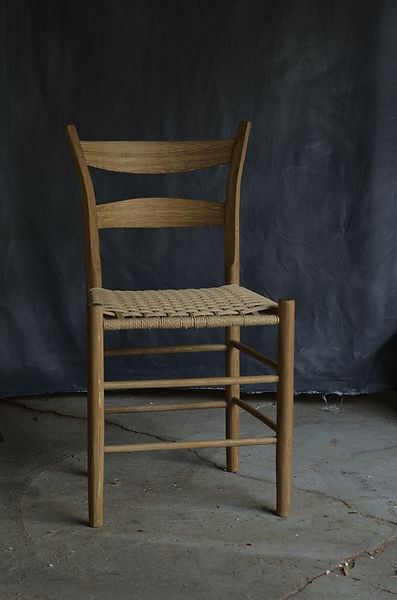
Learn to make a vernacular two-board chair in an Alpine vernacular. This class is centered around joinery, relief carving, and design. Students will use hand tools to create components and joints, including tapered sliding dovetails and through-tenons. Each student will also develop a vocabulary in pattern carving throughout the week. Finally, students can either work from a template and carve their chair or compile their own practiced patterns onto a chair back of their own design. All levels are welcome; elements of this class may be physically strenuous.
Greenwood Spooncarving
October 5-9
Center for Furniture Craftsmanship
Carving spoons from green wood sparks a conversation between material, environment, and handwork. Carving from branch-to-spoon, students learn to use a carving axe and sloyd knife as well as edged-tools like drawknives, spokeshaves, gouges, and the clog-maker’s knife.
Throughout the workshop, Charles covers a variety of styles of spoons stemming from different kinds of materials, including foraged branches, riven straight stock, and steam-bent blanks. Once everyone has a few spoons in their pockets, the class progresses to decorative techniques like chip carving and milk painting. As time allows, students assemble their own sloyd knife with decorative handle and bark sheath.

Greenwood Spoon Carving - Teaching a Tree to Talk
October 19 - 23, 2026
The Woodworking School at Pinecroft
Spend a week in shop, forest, and field learning how to make a spoon from a tree.
Carving spoons from green wood sparks a conversation between material, environment, and handwork. Our goal will be to develop and convene carving processes that can be carried forward. We’ll do this work over tea, observational hikes, snacks, and with any luck good idle chatter.
For most of the week, our focus will be on carving from branch-to-spoon with the carving axe and sloyd knife. We’ll also be introduced to working with edged-tools like drawknives, spokeshaves, gouges, and the clog-maker’s knife. Throughout the week, we’ll learn several styles of spoons stemming from different kinds of materials, including foraged branches, riven straight stock, and steambent blanks. After we have a few spoons in our pockets, we’ll learn decorative techniques like chip carving and milk painting.
The capstone of the class will be assembling our own sloyd knife and bark sheath.